Friday, June 8, 2012

The issue of Women in Refrigerators

This post continues a conversation started earlier on this blog on the status of women in comic books. Anita Sarkeesian over at Feminist Frequency is a pop culture media critic who produces an ongoing video series in collaboration with Bitch Magazine regarding tropes in popular media that marginalize and trivialize women. The second part of this series deals with the Women in Refrigerators trope that occurs quite frequently in comic books and across popular media:
When [Gail] Simone released her list [of over 90 comics that featured female superheroes who suffered a loss of super powers, brutal violation or an untimely, gruesome death] in 1999 there was an instant backlash from some comic book fans who thought it was unfair that they were singling out female characters. This criticism happens whenever we point out tropes specifically about women. In this case, comic book fans criticized the Women in Refrigerators by saying that male heroes get killed and tortured too so what’s the big deal? The people who run the Women in Refrigerators website responded to this by creating another trope (how much do I love fans!) called Dead Men Defrosting. Comic fan John Bartol explains, “In cases where males heroes have been altered or appear to die they usually come back even better than before, either power-wise or in terms of character development/relevancy to the reader." 


This video is quite enlightening. For more information check out these related links:

Thursday, June 7, 2012

Homemade Frappuccinos!

I've been contemplating how to make my own homemade Frappuccinos for some time now. After a few orders at Starbucks, where I asked for a non-sweetened Frappuccino and thoroughly confused the baristas, I discovered that the coffee Starbucks uses for their Frappuccinos is pre-sweetened (in both real sugar and sugar-free varieties). This was confirmed when I discovered that The Coffee Bean and Tea Leaf sells a pre-packaged coffee base for their Iced Blendeds (their equally delicious version of a Frappuccino).

Using this information, I determined that my previous attempts at making homemade Frappuccinos had failed because I used plain coffee, which resulted in a drink that was slightly too watery and didn't pack the punch of the drinks I ordered at national chains.

So last night I went on a mission to develop my own coffee base. Using what I know about brewing tea, I determined that the coffee I brewed for my base would need to be twice as strong as what I would normally drink. So I doubled the number of scoops of grounds per cup compared to what I would normally brew. Once the coffee finished brewing I dissolved two cups of sugar in the brew, and set it to chill in the fridge.

This afternoon I put together a Frappuccino based on what I had figured out by watching baristas make my drinks for years now. I filled the cup of my compact blender (I use the Cuisinart CPB-300 SmartPower model, but my parents use the Cooks 5-in-1 Rocket, and they're both excellent) with an inch of the coffee base, then filled it the rest of the way with ice. I finished by pouring in enough milk to cover the ice and blended my drink! The result was about the same flavor and consistency as the Starbucks variety, although I would prefer it slightly less sweet and with a thicker milk (I used nonfat milk, and prefer 2%  or 4% milkfat).

I wish I had pictures to share with you, but I promise the drink is delicious! I added some caramel syrup to mine to recreate the caramel-flavored Frappuccino, which is my favorite, but with an at-home recipe you can blend it any way you want!

Friday, June 1, 2012

Teaching Boys Feminism

Ileana Jiménez over at The Feminist Teacher wrote an excellent post last March about teaching young boys feminism and how it affects their lives. Read the excerpt below, then check out the full post here.
I’ve read many horror stories about women’s studies professors being heckled by male students who are just there to make a sexist scene. In the high school setting where I teach, I have never had that experience. Instead, the boys in my classes are curious about how feminism might connect to their lives. They want to know if feminism can help them become better versions of themselves in a world that tells them only one version is acceptable.

The boys in my feminism course have taught me that it is essential that we teach them about the various global feminisms so that we can finally reach gender, racial, and economic justice together as fully realized men and women. They have taught me that it is crucial that we bring a feminist lens to not only high school classrooms but middle and elementary schools as well.

Tuesday, May 22, 2012

The Last Name Project

My contribution to The Last Name Project has been featured over at The Feminist Mystique! Check it out here, or read my write-up below:


In this new series co-hosted by from two to one and The Feminist Mystique, we will be profiling an array of individuals and couples about their last name decisions upon marriage or what they expect to choose if they marry. The goal is to explore how individuals make decisions about their last name, and to highlight the many possibilities. We will be posting profiles periodically and encourage you to stay connected via FacebookTwitter, and Pinterest.  If you would like to participate in this series, email Danielle at danielle [at] fromtwotoone [dot] com or Shannon at hill [dot] shannonp [at] gmail [dot] com.  

Although I am not married, I have spent years thinking about whether I am going to keep my name when I do get married. For most of my life, aesthetic has been the primary deciding point for me; does the name flow off the tongue appropriately? I remember that when I was about five years old, I just knew that I was going to marry my best friend Joshua one day. I also remember deciding that—since he was of Polish descent, and his name was much too difficult to spell—he was going to have to take my name if I would agree to the marriage at all. A practical decision, perhaps, had I not eventually learned how to spell his name (really, Polish spelling isn't that hard!).

Of course, my friendship with Joshua didn't last after my family moved away, but the notion of keeping a practical name stuck with me. Ease of spelling grew less important, since I have the privilege of a mother with two difficult to spell names (Ouida Juanette), and an aunt whose name features a letter not in the English character set (Aïda). It was not until I got together with my current boyfriend, Marc, that I really started considering the possibility of keeping my name. I was not looking forward to having an alliterative name (since his last name is Kashiwagi), but that wasn't what decided things for me. Instead, it was meeting his mother, an early-second-wave feminist who kept her last name when she got married. Her reasoning behind keeping her own name was that since she had been published and received several degrees in her name, it made no sense to change it because of custom. She also handles having a different name from her husband and son with grace. I admire her strength of character; after marrying Marc's father the two of them immediately moved to Saudi Arabia where she faced the difficulties of being a feminist in a country with a history of oppression of women. 

The practical points she made about keeping a name that had been linked to her in published work (an important consideration for me as a sometime-published writer) resonated with me, and reminded me about my own beliefs about names. I believe that my family names are a part of who I am, and changing my name would remove a certain part of my identity. I want to preserve my family heritage, and I claim my grandmothers' family names with as much pride as my grandfathers'. 

Around the same time that I first met Marc's mother, I took a class in Spanish culture, and learned that the Spanish have an interesting approach to naming, and one that I wish the United States legal system would honor. In Spanish culture, each person has two last names: their father's family name and their mother's family name. Upon marriage, a woman does not change her name, and she does not take on a part of her husband's name. Instead, their marriage is recognized in the names of their children, who take their father's family name and their mother's family name. If my family used this system, my name would not be Katelyn Celeste Willis, but it would be Katelyn Celeste Willis Bales, and my mother's name would be Ouida Juanette Bales Riddick, and my father's name Gerald Kenneth Willis Barden. My children, were I to have any with my current boyfriend, would take the last names Kashiwagi Willis, not hyphenated.

What I like about the Spanish system is its elegance; it preserves the matrilineal heritage while allowing women to keep their own names. It solves the problem of trying to decide which name the children should take. And it would make researching family trees so much easier! In an ideal world, my family would use this system of naming. Feminism, to me, is about cherishing one's identity and having the right to be who you are. How can you do that without honoring and acknowledging all of your names?

Tuesday, May 15, 2012

Summer

Now that it is starting to (finally) feel like this semester's over, it is time for me to make a summer to-do list. Since I will be between programs, I want to spend the summer trying to pick up a few new hobbies that I can hope to integrate into my schedule when my new program starts. These are activities I have always wanted to try to pick up but never have felt like I had the time to build the habit while I've been in school. So here are some goals I have for the summer:

Take up yoga

I have flirted with yoga through the years, taking a few classes here and there, but I have not been able to satisfactorily fit it into my routine. This is in part because I am not a morning person, and the few yoga classes I have had access to as a student have been early morning. I've been looking at a few yoga studios around Decatur, hoping to find something within my student budget that will be near Emory and also near where my mom works; yoga's more fun with your mom! Maybe this summer I can check out a few of the classes ahead of time and see if they'll work for me.

Take up gardening

As part of my education in 5-8 grades, I worked in a greenhouse growing plants native to the Chihuahuan Desert as part of an ecological project within the National Park system. I absolutely loved the hands-on experience, and getting to play in dirt was an added bonus (fun fact: I find dirt absolutely fascinating, and was super-disappointed that I missed the dirt exhibit at the Smithsonian when I was in DC for the inauguration). Since I moved away from Big Bend, however, I haven't enjoyed the pleasures of working with dirt to grow beautiful things.


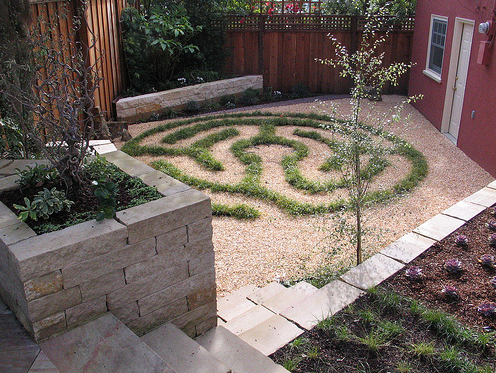
One particular goal I have in mind is trying to plant a labyrinth somewhere in my parents' yard. I've always loved the spiritual practice of walking a labyrinth, and I recently read about labyrinths being used for physical therapy. I would love to have a semi-permanent labyrinth in our yard both for its meditative benefits but also as an activity to do with my dad.

I have also recently become fascinated with vertical gardens, and would love to try building one. Home Depot recently released a PDF of instructions for how to build your own, so I'm thinking about trying to take up the project over the summer. I can just picture how much I would enjoy "painting" with living plants.

Take up biking

When I was younger, mom and I would bike everywhere. One of our favorite things to do in Big Bend was take scenic bike rides; we would have dad drop us off at a certain location with our bikes, and then tell him to meet us at an agreed-upon destination. Big Bend had a lot of beautiful scenery and challenging landscapes for biking, and it was so fulfilling at the end of the day to say that we had biked for 20 miles just to see the beautiful landscapes.
The bike I would love to be riding

I would really like to get into the habit of biking more frequently and using my car less often. Georgia will be hard to get used to biking in--especially after not biking for so many years--since there are so many hills, but with the right bike and a lot of practice, I think I'll be fine.

Organize closets, cabinets, and other storage spaces

My friend Kim over at The Gracious Gaze has some really handy tips on building and maintaining an ideal (simple) closet. And what I discovered from reading her posts is that I own way too much stuff. Part of my moving out process has been going through and seeing what I have that I don't need and throwing it out or donating it, and I am perhaps being overly ambitious in deciding I want to go through the closets, cabinets, bookshelves, etc once I arrive home. I get so much joy out of a neatly organized space.

And maybe I'll be able to talk my mom into letting me repaint their kitchen like I want to do.

Write a paper

And this is the part of my checklist that reveals exactly how much I am cut out for academics. You'd think that after leaving a three-year Master's program that required lots of paper-writing and before entering a Master's program in which I will be expected to write a thesis, I would want to take a break from paper-writing for just one summer. But the truth is, I love the idea of getting to do research and write a paper just for me. I get to read the things I am interested in and write about the things I am interested in. And if I do it right, maybe I can use it as a writing sample for PhD applications (!).

...and, finally

I want to post more frequently on this blog. I love being able to write on a regular basis about whatever I'm thinking. If you're lucky, I'll start blogging about all of my fun recipes and gardening projects. Or maybe I'll update you with some of my random creative writing projects. The point is, I want to post more, and hopefully it will be entertaining and meaningful for you as well!

Wednesday, May 9, 2012

On "cunt," "bitch," and other bad words

I should have been a Women's, Gender, and Sexuality Studies major in undergrad.

The other night, I got into a (rather exhausting and time-consuming) debate with a friend of mine on Skype. Although my (white, male, Catholic) friend, whom I will refer to henceforth as Mr X, tried to make many arguments to the point of "why people should not be offended by the language I use and the [racist and sexist] jokes I make," the real debate centered around whether or not "cunt" was an insult. While there is an obvious answer to this question (It's an insult if it's used like an insult!), the ethicist, linguist, and advocate inside of me attempted to tease out the subtleties of privilege and misogyny in the use of such a word.

One of Mr X's favorite points, and one I see bandied about quite a bit on the internet, is the fact that "cunt" refers to female genitalia, much in the same way that "dick" refers to male genitalia and therefore, "cunt" is no more insulting than "dick." What Mr X understood to be important was how the word was intended, and not how it was understood by the interlocutor. This argument sets up a false understanding of the dichotomy of insults. Melissa McEwan, who runs a blog series called Feminism 101 over at Shakesville, summarizes the counterpoint beautifully in her article "On 'Bitch' and Other Misogynistic Language":
Intent: If you're turning part of a woman's body into a slur to insult someone, the implication is necessarily that cunts are bad, nasty, less than, in some way something that a person wouldn't want to be or be associated with. That's how insults work. When cunt is used as a slur, it is dependent on construing a woman's body part negatively—and it thusly misogynistic, because it inexorably insults women in the process. Specifically using a misogynistic slur against a man can't be anything but intentionally misogynistic. If you don't intend to demean women, then don't use misogynistic slurs. It's really as simple as that.
While Melissa's reasoning might suggest that calling a man a "dick" implies that dicks are bad, nasty, less than, and in some way something that a person would not want to be or to be associated with, calling a man a dick is not demeaning. Calling a man a dick is not demeaning because a dick is not understood to be an unfavorable possession; having a dick is a sign of male privilege. In minority studies, privilege means that opportunities and status are awarded to a group of people on the basis of normalcy. Privilege is socially constructed, and an individual may have privilege or not have privilege depending on the society he or she is in. Unfortunately, men are almost universally recipients of privilege, and women are not. Because of this power relationship, using an insult that demeans a man does not carry the same weight as one that demeans a woman because of the history of oppression that is linked to demeaning and marginalizing women (and other minority groups who suffer). The argument can be applied to slurs against other minority groups as well.

Another point made by Mr X is that "cunt" cannot be an insult because women use it themselves to describe themselves (or similarly, Chris Rock makes fun of black people; why can't I?). The problem here is that a woman using the word in a reclamatory fashion is fundamentally different from a man using it as an insult. Not recognizing that there is a difference is what August Pollack calls a fabricated belief. The fact that women feel the need to reclaim the words "cunt" and "bitch" is proof enough of their derogatory nature; they would not need to be reclaimed if they were not an insult from the beginning. Or, as Derailing for Dummies puts it:
What this enables you to ignore is the reality of the power dynamic involved. Language reclaimation is a means by which Marginalised People™ gain back some power they are traditionally denied by taking control of words used to demean and discriminate against them. When these words come from Privileged People®, there is a long and very serious negative history behind them that cannot be divorced from the words themselves. Thus, when Privileged People® employ these words, they are perpetuating that history and the psychology behind the word. They are exercising oppressive power that have become inherent to those words - a power Marginalised People™ seek to subvert and dismantle when they use them. 
This is why I refuse to listen if I hear someone referring to others by hateful language. Don't be calling other people "cunt" and "bitch" while I'm around, even if you "don't mean it that way." Using misogynist language and attempting to divorce it from its context perpetuates the problem of gender inequality, and I won't stand for it.

And no, I'm not being oversensitive.

Tuesday, May 8, 2012

Women and sexuality in comic books

Since the Avengers movie was released, an image has been circling the various social networks depicting how the male Avengers would look had they been posed the same way that women in comic books are almost universally drawn. Although this is topic that comes up quite frequently in girl geek communities, the inevitable male response is usually "Men are idealized in comics, too," or, somewhat less frequently, "I like my lady superheroes sexy." And while there is truth to the statement that men are idealized in comics as well, the way they are idealized is different. David Willis, the author/artist of the webcomic Shortpacked , summarizes the difference in this wonderful comic strip (click to enlarge):


While I have a lot of thoughts on the subject of the depiction of women in comics (and their movie counterparts), my good friend Keith has compiled a wonderful collection of blog posts regarding the matter, which are entirely more eloquent than I am:

Dressed to Kill
Men in Skintight Leotards
What if male superheroes posed like Wonder Woman on the David Finch Justice League cover?

These in no way explore the depth of the problem, but they are a good introduction!